Consistent Eating · The EPK framework · 7 October 2026
Resting needs are not your whole day
From the first edition’s activity table to today’s wearable estimates: how to use energy numbers without counting the same calories twice.
EPK gives a name to the framework discussed in the original Consistent Eating: understanding energy needs and making adequate nourishment practical and consistent.
Name the number before using it
From Chapter 11:
A resting metabolic measurement estimates expenditure under defined resting conditions. Daily living includes more than that. Movement, the processing of food and other demands contribute to total expenditure. The number used to plan a whole day's nourishment must be understood in those terms; a resting figure should not quietly become a ceiling for total intake.
Before comparing two calorie figures, check whether they describe intake, expenditure at rest, activity expenditure or total daily expenditure. Dividing each by body mass does not make these different quantities interchangeable.
What the original activity table was trying to show
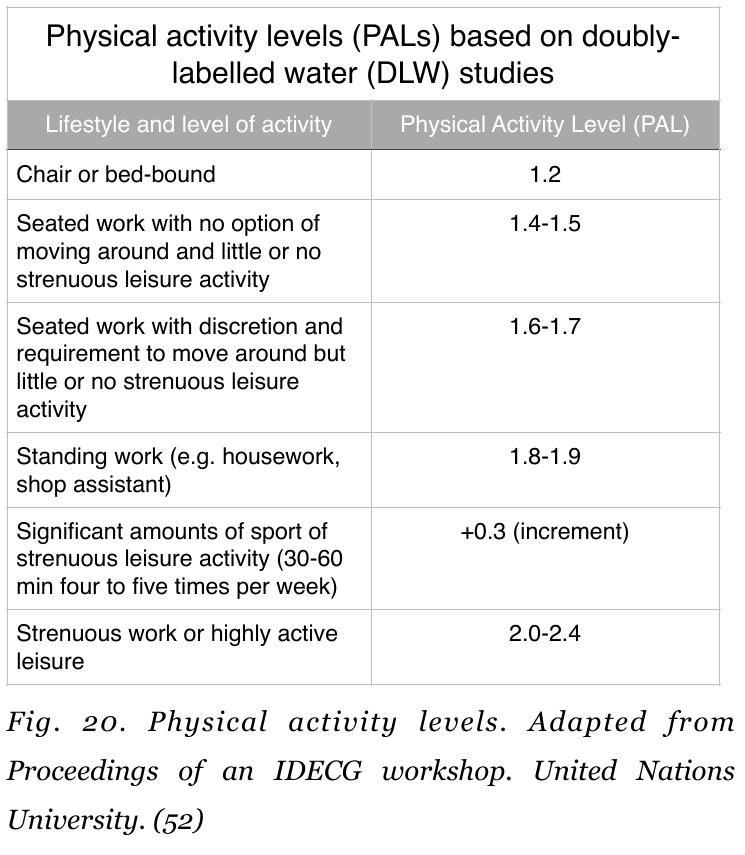
Read the figure as text
The original table lists PAL 1.2 for chair or bed confinement; 1.4–1.5 for seated work with little activity; 1.6–1.7 for seated work with more movement; 1.8–1.9 for standing work; and 2.0–2.4 for strenuous work or highly active leisure. Its exercise increment of 0.3 is part of that historical classification, not an instruction to add it to a wearable total.
The table in the first edition made a simple point: a day spent moving is different from a day spent resting. PAL, the physical activity level, expresses total daily expenditure relative to basal expenditure. The FAO/WHO/UNU report also emphasises the whole lifestyle rather than occupation alone. [1]
The original categories should not be read as a personal measurement. The later FAO framework uses ranges, including 1.40–1.69 for sedentary or light activity lifestyles. A very low value associated with confinement is not a general target for an ordinary working day. [1]
A worked example, not a prescription
For a hypothetical adult with basal expenditure of 1,600 kcal/day, an estimated PAL of 1.5 gives 2,400 kcal/day. At 80 kg, the basal figure is 20 kcal/kg/day and the total estimate is 30 kcal/kg/day. The arithmetic is straightforward; deciding whether the assumptions fit the person is the difficult part.
If a wearable already reports total daily expenditure, adding another 1,600 kcal of resting needs would double-count that component. Conversely, treating activity calories alone as the whole day would omit resting expenditure. Device labels and data definitions matter.
More personal observations, still an estimate
A wearable can record information about the day that a fixed activity category misses. That is a reason to consider it; it is not proof that its calorie estimate is accurate. Murakami and colleagues tested 12 devices against metabolic-chamber and doubly labelled water methods. The 2019 analysis found substantial limitations in estimates of physical activity energy expenditure. It examined those devices and conditions, not every current wearable. [2]
Within EPK, the five-day learning period is a way to assemble an initial baseline. Five days do not independently validate an individual’s expenditure or capture every kind of week. Missing wear time, unusual activity and changes in routine still need to be considered.
Use the estimate alongside the experience it is supposed to explain. If the routine repeatedly leaves you struggling, revisit the assumptions and food arrangements. The purpose is a more workable starting point for nourishment, followed by review—not an apparently exact ceiling that never changes.
More from Consistent Eating
Research and guidance
Explore more studies in the research library.
- FAO/WHO/UNU. Human energy requirements. 2004. Chapter 5: Energy requirements of adults.
- Murakami H et al. Accuracy of 12 wearable devices for estimating physical activity energy expenditure using a metabolic chamber and the doubly labeled water method: validation study. JMIR mHealth and uHealth. 2019;7:e13938.
Related working papers
Read the relevant PDFs: EPK–001 to 007 are the revised version 1.2 papers; EPK–008 to 010 are version 1.0 supplements. Earlier PDFs and DOI records remain on the paper archive.