Consistent Eating · The EPK framework · 7 October 2026
Not every kilogram has the same energy needs
An original Consistent Eating figure explains why body mass gives useful context—and why kcal/kg is not a universal metabolic score.
EPK gives a name to the framework discussed in the original Consistent Eating: understanding energy needs and making adequate nourishment practical and consistent.
Keep the context attached to EPK
From Chapter 11, “Why 25 is not a pass mark”:
Expressing energy per kilogram can make comparisons easier to discuss. It cannot remove all the differences between people. Body composition, body size, age and measurement conditions still matter. A simple ratio also behaves differently from a statistical adjustment for the tissues that contribute to expenditure. Two people with the same ratio need not have the same physiology.
The useful question is what a ratio helps us understand. Energy per kilogram makes the relationship between an energy figure and body mass explicit. It does not tell us which tissues account for that mass or how their needs differ.
The original illustration
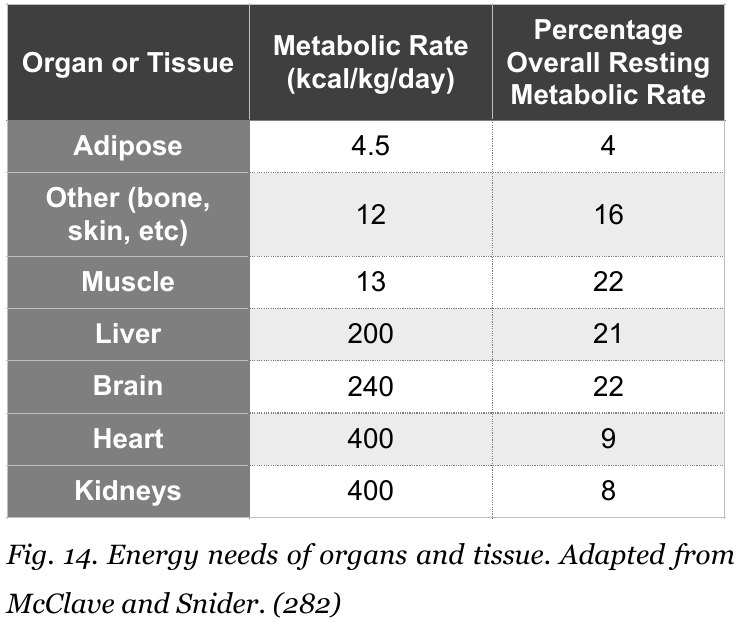
Read the figure as text
The first-edition table gives tissue-specific estimates of 4.5 kcal/kg/day for adipose tissue, 12 for other tissue, 13 for muscle, 200 for liver, 240 for brain and 400 for heart and kidneys. Its illustrative shares of resting expenditure are 4%, 16%, 22%, 21%, 22%, 9% and 8% respectively. Those shares are not fixed percentages for every person.
The important feature is the contrast between tissues. A kilogram of liver or brain is not metabolically equivalent to a kilogram of adipose tissue. McClave and Snider’s review explains why a small proportion of body mass can account for a large share of resting expenditure. [1]
Read the units carefully. The table’s liver value refers to a kilogram of liver, not a kilogram of the whole person. Multiplying that value by someone’s total body mass would be a fundamental error. The percentages in the final column describe an illustrative distribution, not a personal test result.
The original table rounds heart and kidney values to 400. Other widely used organ models give approximately 440 kcal/kg/day for those tissues. This is another reason to use the figure to explain the principle rather than as a clinical calculator. [2]
Why a lower ratio need not mean a damaged metabolism
Consider two hypothetical adults. One has a resting expenditure of 1,500 kcal/day at 60 kg: 25 kcal/kg/day. Another has a resting expenditure of 1,800 kcal/day at 90 kg: 20 kcal/kg/day. The second person has the higher absolute resting expenditure and the lower ratio. Both statements are true.
Those invented figures diagnose nothing about either person. They demonstrate why sorting people by the ratio alone can mislead. Body-composition models provide a more detailed account by considering the masses and assumed metabolic rates of different tissues. Even these models have assumptions and cannot replace an appropriate individual assessment. [2]
What this changes in practice
When recording EPK, retain the original daily calorie estimate, the body-mass measurement, the date and what the calorie figure represents. That makes it possible to understand why the ratio changed. A new number might reflect a change in the estimate, the denominator or both.
Do not turn a comparison with another person into a demand to eat an identical amount per kilogram. The same caution applies when comparing adults with children or interpreting a population average. Similar units do not guarantee comparable physiology.
The framework becomes more useful when it encourages better questions: what was measured, what was estimated, and does the eating arrangement support the person’s life? The aim remains dependable nourishment and a routine that can be sustained. A ratio can organise information; it cannot settle those questions on its own.
More from Consistent Eating
Research and guidance
Explore more studies in the research library.
Related working papers
Read the relevant PDFs: EPK–001 to 007 are the revised version 1.2 papers; EPK–008 to 010 are version 1.0 supplements. Earlier PDFs and DOI records remain on the paper archive.